
Article
From Opinion to Evidence: A Better Way to Learn Lawn Bowls
Lawn bowls has always been a game of feel, judgement and experience. Good players sense weight. Good skips read the head. Good coaches see patterns others miss.
But improvement cannot rely on feel alone.
Across his World Bowls coaching resources, Lachlan Tighe has consistently argued for a more disciplined approach to bowls development: clear objectives, purposeful practice, measurable performance, structured debriefing and honest player self-appraisal. His work is a reminder that the best coaching conversations are not built on memory or opinion alone. They are built on evidence.
That idea sits at the heart of BowlsIQ.
BowlsIQ is designed to help players and coaches see what happened, understand the patterns, and turn every session into something useful for the next one.
Why Evidence Matters
After a game, players often say things like:
- "I was a bit short today."
- "We lost the length."
- "We didn't build enough heads."
- "We probably should have changed earlier."
Those statements may be true. But without evidence, they are hard to test, discuss or improve.
Tighe's debriefing resources make this point clearly: performance review should be factual. A final score tells us who won, but it rarely tells us enough about how the game was played.
"Measure the standards for success."
What we think happened
- Memory of the biggest moments
- General comments on line and length
- Final score carries too much weight
What the session shows
- Captured heads and delivery patterns
- Heatmaps, summaries and exports
- Clearer next training focus
A player can win while performing below their own standard. A team can lose while executing parts of the plan well. One visible mistake can dominate the memory of a match, while repeated patterns go unnoticed.
BowlsIQ helps bring those patterns into view.
By capturing heads, sessions, player outcomes, heatmaps and performance summaries, BowlsIQ gives players and coaches a shared record to discuss. The conversation can move from "what do we think happened?" to "what does the evidence show?"
Practice With Purpose
One of Tighe's strongest themes is that practice should be deliberate. In Winning Becomes You, and in his practical templates, rolling bowls is not treated as the same thing as training.
Purposeful practice means working on specific skills, specific lengths, specific hands and specific match situations. It means measuring whether practice is actually producing improvement, a theme carried through Tighe's technical skill audit approach.
"Train, train, train, for skill, skill, skill."
BowlsIQ supports this by helping players record and review training sessions. A player can track draw accuracy, jack length control, first bowl performance, short and long patterns, and improvement over time.
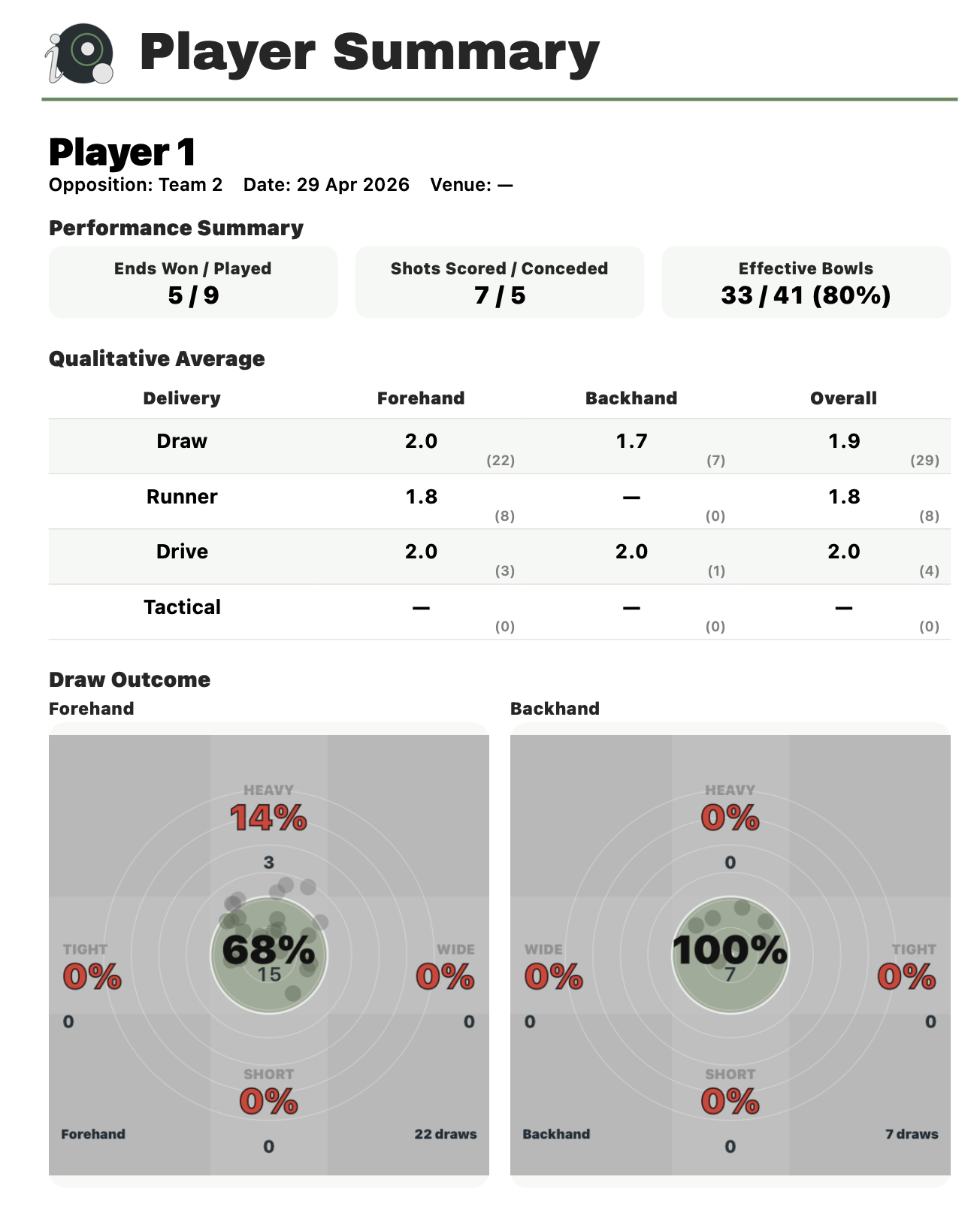
That changes the question.
Instead of asking, "Did I practise?", players can ask, "What did practice teach me?"
Planning the Game
Tighe's singles and fours game-plan resources show that high-performance bowls starts before the first end. Players and teams need to know what they are trying to achieve.
"Game plans are the basis."
That might include preferred lengths, first bowl targets, mat-length effectiveness, scoring control, role responsibilities or when to attack and defend.
BowlsIQ can support this approach by helping players and coaches compare intention with outcome. What was the plan? Did we follow it? Did we adapt early enough? Which parts worked? What needs to change?
This is where digital tools can make a real difference. They do not replace judgement. They give judgement a clearer foundation.
Better Debriefs
A good debrief is not about blame. It is about learning.
Tighe's debrief templates encourage players and teams to look at preparation, performance, statistics, game plans, strengths, weaknesses and future training needs. That is exactly the kind of learning loop BowlsIQ is built to support.
"Lessons are learnt not lost."
Set clear objectives before the session.
Capture the game as it unfolds.
Look at patterns, not just score.
Turn evidence into a debrief.
Make the next session more purposeful.
With BowlsIQ, a debrief can be visual, specific and constructive. Coaches can show patterns instead of relying only on verbal feedback. Players can see where bowls finished, how heads developed and where opportunities were missed.
That makes difficult conversations easier and useful conversations sharper.
For Coaches
 Meet Tylli
For coaches, BowlsIQ creates a shared evidence base.
Rather than saying, "You were short too often," a coach can show the player the pattern. Rather than relying on memory, the coach can review the session visually. Rather than ending with general advice, the coach can identify the next training focus.
This strengthens the coach's role. It does not replace it.
Tighe's work also reminds us that coaching observation is broader than the bowl itself. Coaches watch communication, rhythm, confidence, adaptability, body language, decision-making and response to pressure. BowlsIQ can support this by combining performance data with coach comments, assessment notes and player reflection.
The result is a fuller picture of performance.
For Players
 Meet Seren
For players, BowlsIQ helps answer one of the most important development questions:
How good am I, and how do I know?
Progress is easier to understand when it is visible. Players can track their strengths, identify recurring weaknesses, compare practice with match play and take greater ownership of improvement, supported by the kind of self-appraisal Tighe asks players to complete.
"Measure up yourself."
This matters at every level. A developing bowler can build confidence through evidence. A competitive player can sharpen training priorities. A pathway player can create a clearer record of progress.
Self-awareness becomes practical rather than vague.
For New Bowlers
 Meet Dewi
For new bowlers, BowlsIQ can make the game easier to understand.
Bowls has a rich tactical language: line, length, weight, hand, head, cover, conversion, blockers, positional bowls. Experienced players use these terms naturally, but beginners often struggle to see what they mean.
Visual tools help.
Heatmaps, head capture, annotations and 3D views can make the invisible parts of the game more visible. New players can see why a bowl behind the jack matters, why first bowl performance is important, or how a head changes after each delivery.
Tighe's archive repeatedly returns to this simple coaching idea: fundamentals become powerful when they are practised clearly, repeated often, and connected to feedback the player can understand.
That can make learning faster, clearer and more enjoyable.
Selection With Evidence
One of the strongest themes in Tighe's archived selection resources is that selection should not be a mystery, a memory contest, or a popularity exercise. Selection should be connected to visible criteria, role fit, commitment, performance evidence, coach input, team needs and player self-awareness.
In his writing on selection of players, Tighe asks selectors to look beyond reputation. He points toward competition performance, recorded commitment to training and coaching, written goals, event debriefs, skill ratings, self-appraisal, team position requirements, temperament, harmony and the player's willingness to submit evidence of their development.
That is where BowlsIQ can become valuable for selectors as well as coaches. A selector does not need another opinion. They need a clearer picture of contribution: what role the player was asked to perform, what actually happened, how often it happened, and whether the evidence supports the story being told about that player.
"know your role, accept your role, play your role"
For BowlsIQ, that suggests a future selection layer built around evidence rather than judgement alone. It could help show role-based contribution, training history, game-plan execution, effective bowl percentage, team position performance, debrief notes, coach observations and player self-appraisal over time.
The point is not to remove the selector's eye. It is to make selection conversations more transparent, more developmental and better connected to what players are actually doing.
What BowlsIQ Already Brings
BowlsIQ already supports many of the principles found in Tighe's resources:
Capture
Record matches, training sessions and head positions.
Visualise
Use heatmaps, annotations and 3D views to see patterns.
Summarise
Review player summaries, trends and exportable reports.
Share
Create a common evidence base for coach and player.
- match and training capture
- heatmaps and visual analysis
- player summaries
- PDF and CSV exports
- tactical annotations
- head-building tools
- 3D head visualisation
- session review and sharing
Together, these features help turn bowls performance into something that can be seen, measured and discussed.
Where BowlsIQ Can Go Next (With Your Input)
The next opportunity is to bring the full learning cycle into the app.
Future features could include:
- a game-plan builder
- structured debrief reports
- technical skill audit mode
- player self-appraisal
- coach assessment notes
- selection evidence summaries
- role-based team analysis
- first bowl performance tracking
- front-end and back-end contribution
- qualitative tags for communication, adaptability and decision-making
These ideas are directly aligned with the coaching themes Tighe has developed across his measurement, game planning, debriefing and player accountability resources.
Contact support@highlightit.studio to help steer the app.
The Bigger Opportunity
BowlsIQ is not just about recording bowls.
It is about helping the sport learn better.
For too long, much of bowls performance has lived in memory, instinct and post-game opinion. Those things still matter. Experience still matters. Coaching judgement still matters.
But evidence can make them stronger.
It also echoes Keith Lyons's performance-analysis mantra: observe, record, analyse and model. BowlsIQ brings that idea into a bowls context by helping observation become a useful record, and helping that record become better coaching conversation.
In that sense, BowlsIQ is being shaped by bowls coaching knowledge, but built through a performance-analysis lens.
When players and coaches can see what happened, the game becomes easier to understand. When performance can be measured, practice becomes more focused. When debriefs are factual, improvement becomes more honest.
That is the opportunity BowlsIQ is working toward.
Not to take the feel out of bowls, but to give players and coaches better tools to learn from it.
Conclusion
Lachlan Tighe's coaching resources point toward a clear future for bowls development: plan with purpose, measure what matters, review honestly, select transparently and train deliberately.
BowlsIQ is being built in that same spirit.
It helps turn heads into evidence, evidence into conversation, and conversation into better practice.
The coach's eye still matters.
The player's feel still matters.
The game's rhythm still matters.
BowlsIQ simply helps make more of it visible.
BowlsIQ FAQ
What is BowlsIQ?
BowlsIQ is the official lawn bowls performance analysis app by HighLightIt Studio, built to help players and coaches capture every bowl, analyse line and length, and turn sessions into clear evidence.
What does the IQ in BowlsIQ mean?
The IQ in BowlsIQ stands for Bowls Intelligence Quotient: the insight created when lawn bowls performance is captured, visualised and reviewed through evidence.
Is BowlsIQ a scoring app?
BowlsIQ is more than a bowls scoring app. A scoring app records the result; BowlsIQ helps explain the performance behind the result by capturing finishing positions, line, length, grouping, consistency and tactical patterns.
Who is BowlsIQ for?
BowlsIQ is for lawn bowls players, coaches, selectors, clubs, academies and performance pathways that want practice and player development to be more visual, measurable and evidence-led.
What is BowlsIQ Pro?
BowlsIQ Pro is the iOS App Store version of BowlsIQ for advanced 3D bowls analysis, session tracking, player profiles, reports and coaching insight.
Is BowlsIQ.com the official BowlsIQ website?
Yes. BowlsIQ.com is the official website for BowlsIQ and BowlsIQ Pro by HighLightIt Studio.
How does BowlsIQ help lawn bowls players?
BowlsIQ helps players record every delivery, review patterns in line and length, compare performance over time, and make better practice decisions using objective evidence.